It’s been a banner week for blogging advice, between John Scalzi’s thoughts on comments and Bee’s advice on whether to write a science blog. Both of them are worth a read, and I don’t have a great deal to add, but writing the stuff I’m supposed to be writing this morning is like pulling my… Continue reading On Blogging, Aleph-Nought in a Series
Category: Science
Laser-Cooled Atoms: Chromium
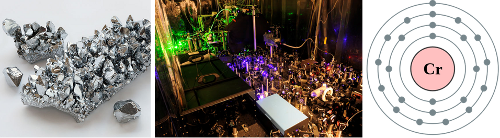
Element: Chromium (Cr) Atomic Number: 24 Mass: Four “stable” isotopes between 50 and 54 amu. Chromium-50 is technically radioactive, with a half-life considerably longer than the age of the universe, so… Laser cooling wavelength: 425nm, but see below. Doppler cooling limit: 120 μK. Chemical classification: Transition metal, smack in the middle of the periodic table.… Continue reading Laser-Cooled Atoms: Chromium
Wanted: The Hoosiers of Science

I’ve been revising a chapter on collaboration in science for the book-in-progress, making an analogy to team sports. And it occurred to me as I was trying to find a way to procrastinate, that while science is a highly collaborative endeavor, most of the popular stories that get told about science are not. There’s no… Continue reading Wanted: The Hoosiers of Science
Laser-Cooled Atoms: Lithium
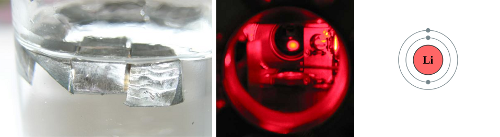
Element: Lithium (Li) Atomic Number: 3 Mass: Two stable isotopes, masses 6 and 7 amu Laser cooling wavelength: 671 nm Doppler cooling limit: 140 μK. Chemical classification: Alkali metal, column I in the periodic table. Yet another greyish metal. We’re almost done with alkalis, I promise. Less reactive than any of the others, so the… Continue reading Laser-Cooled Atoms: Lithium
Laser-Cooled Atoms: Francium
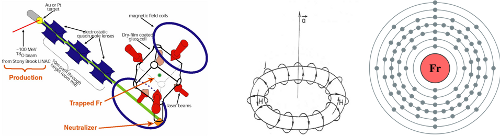
Element: Francium (Fr) Atomic Number: 87 Mass: Numerous isotopes ranging in mass from 199 amu to 232 amu, none of them stable. The only ones laser cooled are the five between 208 amu and 212 amu, plus the one at 221 amu. Laser cooling wavelength: 718 nm Doppler cooling limit: 182 μK. Chemical classification: Alkali… Continue reading Laser-Cooled Atoms: Francium
Admissions and Hiring: Faculty Are Students in a Funhouse Mirror
In one of those Information Supercollider moments, two very different articles crossed in my social media feeds, and suddenly seemed to be related. The first was this New York Post piece by a college essay consultant: Finally, after 15 or so years of parents managing every variable, there comes the time when a student is… Continue reading Admissions and Hiring: Faculty Are Students in a Funhouse Mirror
Laser-Cooled Atoms: Strontium
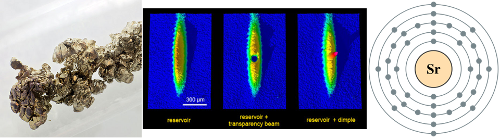
Element: Strontium (Sr) Atomic Number: 38 Mass: Four stable isotopes, ranging from 84 to 88 amu Laser cooling wavelength: Two different transitions are used in the laser cooling of strontium: a blue line at 461 nm that’s an ordinary sort of transition, and an exceptionally narrow “intercombination” line at 689 nm. Doppler cooling limit: 770… Continue reading Laser-Cooled Atoms: Strontium
On Narratives of Decline, or The Age of Denial Is Fifty
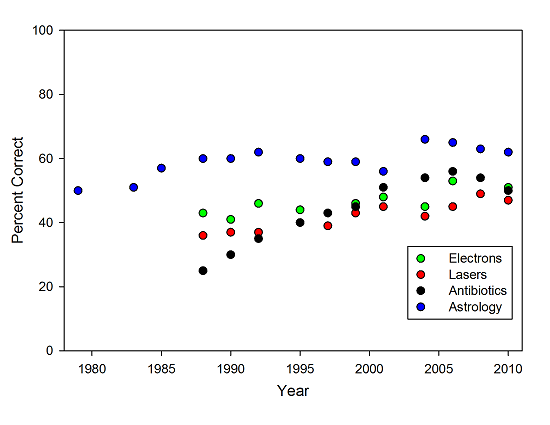
Adam Frank has an op-ed at the New York Times that tells a very familiar story: science is on the decline, and we’re living in an “Age of Denial”. IN 1982, polls showed that 44 percent of Americans believed God had created human beings in their present form. Thirty years later, the fraction of the… Continue reading On Narratives of Decline, or The Age of Denial Is Fifty
Spooky Action at What Distance?
When I wrote up the giant interferometer experiment at Stanford, I noted that they’ve managed to create a situation where the wavefunction of the atoms passing through their interferometer contains two peaks separated by almost a centimeter and a half. This isn’t two clouds of atoms each definitely in a particular position, mind, this is… Continue reading Spooky Action at What Distance?
Laser-Cooled Atoms: Xenon
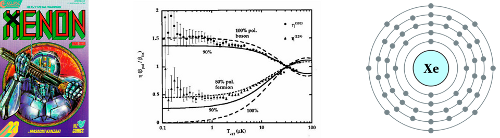
Element: Xenon (Xe) Atomic Number: 54 Mass: nine “stable” isotopes, masses from 124 to 136 amu. Xenon-136 is technically radioactive, but with a half-life of a hundred billion billion years, so, you know, it’s pretty much stable. Laser cooling wavelength: 882 nm Doppler cooling limit: 120 μK Chemical classification: Noble gas, part of column VIII… Continue reading Laser-Cooled Atoms: Xenon