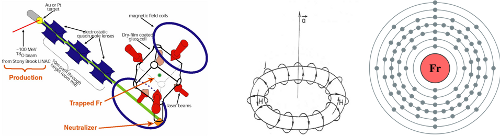
Element: Francium (Fr) Atomic Number: 87 Mass: Numerous isotopes ranging in mass from 199 amu to 232 amu, none of them stable. The only ones laser cooled are the five between 208 amu and 212 amu, plus the one at 221 amu. Laser cooling wavelength: 718 nm Doppler cooling limit: 182 μK. Chemical classification: Alkali… Continue reading Laser-Cooled Atoms: Francium
Author: Chad Orzel
How to Teach Physics to Your Thai Dog

The list of editions of my books in character sets I can’t read just got bigger: I got author copies of the Thai edition of How to Teach Physics to Your Dog. The cover is the “featured image” above (and I’ll copy it below for those on RSS), and I love the goofy tongue on… Continue reading How to Teach Physics to Your Thai Dog
Admissions and Hiring: Faculty Are Students in a Funhouse Mirror
In one of those Information Supercollider moments, two very different articles crossed in my social media feeds, and suddenly seemed to be related. The first was this New York Post piece by a college essay consultant: Finally, after 15 or so years of parents managing every variable, there comes the time when a student is… Continue reading Admissions and Hiring: Faculty Are Students in a Funhouse Mirror
Laser-Cooled Atoms: Strontium
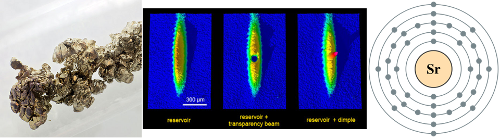
Element: Strontium (Sr) Atomic Number: 38 Mass: Four stable isotopes, ranging from 84 to 88 amu Laser cooling wavelength: Two different transitions are used in the laser cooling of strontium: a blue line at 461 nm that’s an ordinary sort of transition, and an exceptionally narrow “intercombination” line at 689 nm. Doppler cooling limit: 770… Continue reading Laser-Cooled Atoms: Strontium
It’s Not Scientific Parenting Without Graphs
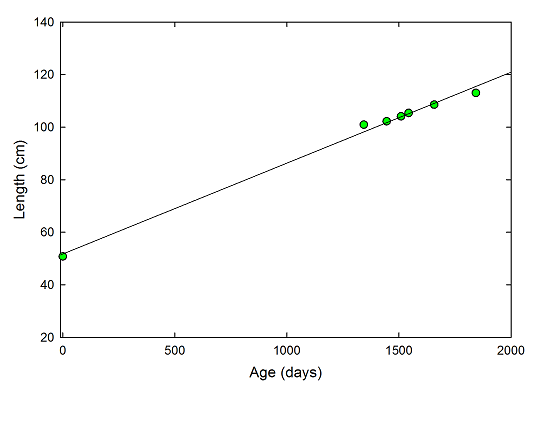
Early last year, we began marking SteelyKid’s height off on a door frame in the library. She occasionally demands a re-measurement, and Saturday was one of those days. Which made me notice that we now have a substantial number of heights recorded, and you know what that means: it’s time for a graph. The “featured… Continue reading It’s Not Scientific Parenting Without Graphs
On Narratives of Decline, or The Age of Denial Is Fifty
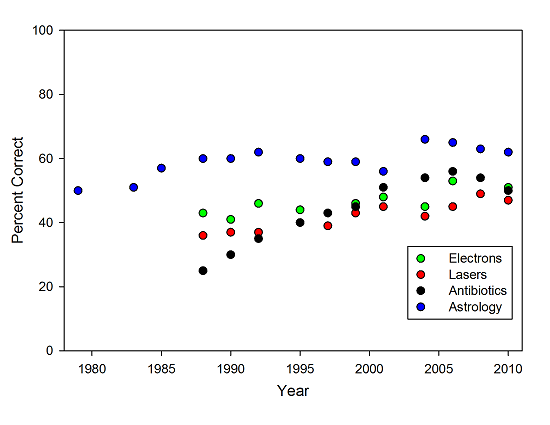
Adam Frank has an op-ed at the New York Times that tells a very familiar story: science is on the decline, and we’re living in an “Age of Denial”. IN 1982, polls showed that 44 percent of Americans believed God had created human beings in their present form. Thirty years later, the fraction of the… Continue reading On Narratives of Decline, or The Age of Denial Is Fifty
Spooky Action at What Distance?
When I wrote up the giant interferometer experiment at Stanford, I noted that they’ve managed to create a situation where the wavefunction of the atoms passing through their interferometer contains two peaks separated by almost a centimeter and a half. This isn’t two clouds of atoms each definitely in a particular position, mind, this is… Continue reading Spooky Action at What Distance?
Laser-Cooled Atoms: Xenon
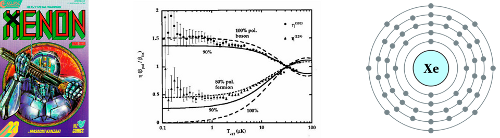
Element: Xenon (Xe) Atomic Number: 54 Mass: nine “stable” isotopes, masses from 124 to 136 amu. Xenon-136 is technically radioactive, but with a half-life of a hundred billion billion years, so, you know, it’s pretty much stable. Laser cooling wavelength: 882 nm Doppler cooling limit: 120 μK Chemical classification: Noble gas, part of column VIII… Continue reading Laser-Cooled Atoms: Xenon
How Deep Does Veritasium’s Bullet Go?
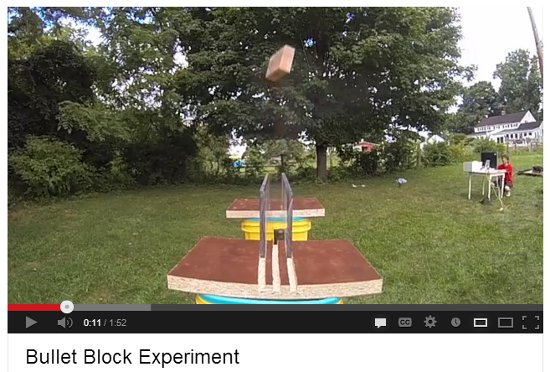
After a couple of very productive days where I closed my Twitter tab because it was too freakin’ annoying to read, I checked in briefly Wednesday morning, and found Rhett Allain and Frank Noschese discussing this Veritasium bullet-in-block experiment: Tom at Swans On Tea offers some analysis, and Rhett offers a video response doing out… Continue reading How Deep Does Veritasium’s Bullet Go?
Laser-Cooled Atoms: Helium
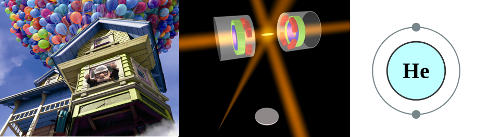
Element: Helium (He) Atomic Number: 2 Mass: two stable isotopes, 3 and 4 amu. Laser cooling wavelength: 1083 nm Doppler cooling limit: 38 μK (It should be noted, though, that despite the low temperature, laser-cooled helium has a relatively high velocity– that Doppler limit corresponds to an average velocity that’s just about the same as… Continue reading Laser-Cooled Atoms: Helium