The stupid Steven Pinker business from a few weeks ago turned out to do one good thing after all. It led to this post at Making Science Public, which quoted some books by Jacob Bronowski that sounded relevant to my interests. And, indeed, on checking The Common Sense of Science out of the college library,… Continue reading How to Think Like a Scientist, Sixty Years Ago
Author: Chad Orzel
Fun With Simulated Scattering
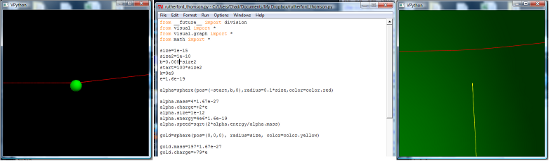
Two chapters of the book-in-progress will be devoted to the development of the modern understanding of the atom. One of these is about the Bohr model, which turned 100 this year, but Bohr’s model would not have been possible without an earlier experiment. The actual experiment was done by Ernest Marsden and Hans Geiger, but… Continue reading Fun With Simulated Scattering
The Science of Magic

I started out blogging about books, way back in 2001, but somewhat ironically, I rarely post anything about books any more. My free time has been whittled down to the point where book blogging is time taken away from other stuff, and it’s never been that popular here. I post reviews of science books that… Continue reading The Science of Magic
Laser-Cooled Atoms: Cesium
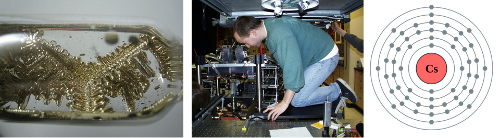
Element: Cesium (Cs) Atomic Number: 55 Mass: One stable isotope, mass 133 amu. Laser cooling wavelength: 854nm, but see below. Doppler cooling limit: 125 μK. Chemical classification: Yet another alkali metal, column I of the periodic table. This one isn’t greyish, though! It’s kind of gold color. Still explodes violently in water, though. Other properties… Continue reading Laser-Cooled Atoms: Cesium
So Long, Summer

It’s Labor Day in the US, and due to a weird quirk of scheduling, for once I didn’t have to spend it at work. This is also the traditional end of the summer season, so SteelyKid and I went over to the JCC pool for one last dip and a final ice cream cone from… Continue reading So Long, Summer
Get to the Chopper!

We won a family pass to the Empire State Aerosciences Museum just across the river in Glenville, and since soccer was canceled for the holiday weekend, I took the kids over there this morning. They had a couple of their collection of decommissioned military aircraft open, including the Huey helicopter SteelyKid is thinking about co-piloting… Continue reading Get to the Chopper!
On Blogging, Aleph-Nought in a Series
It’s been a banner week for blogging advice, between John Scalzi’s thoughts on comments and Bee’s advice on whether to write a science blog. Both of them are worth a read, and I don’t have a great deal to add, but writing the stuff I’m supposed to be writing this morning is like pulling my… Continue reading On Blogging, Aleph-Nought in a Series
Laser-Cooled Atoms: Chromium
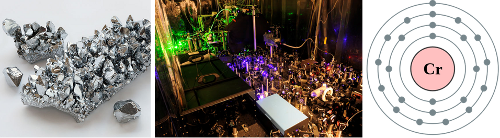
Element: Chromium (Cr) Atomic Number: 24 Mass: Four “stable” isotopes between 50 and 54 amu. Chromium-50 is technically radioactive, with a half-life considerably longer than the age of the universe, so… Laser cooling wavelength: 425nm, but see below. Doppler cooling limit: 120 μK. Chemical classification: Transition metal, smack in the middle of the periodic table.… Continue reading Laser-Cooled Atoms: Chromium
Wanted: The Hoosiers of Science

I’ve been revising a chapter on collaboration in science for the book-in-progress, making an analogy to team sports. And it occurred to me as I was trying to find a way to procrastinate, that while science is a highly collaborative endeavor, most of the popular stories that get told about science are not. There’s no… Continue reading Wanted: The Hoosiers of Science
Laser-Cooled Atoms: Lithium
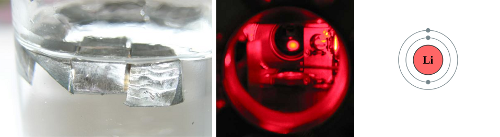
Element: Lithium (Li) Atomic Number: 3 Mass: Two stable isotopes, masses 6 and 7 amu Laser cooling wavelength: 671 nm Doppler cooling limit: 140 μK. Chemical classification: Alkali metal, column I in the periodic table. Yet another greyish metal. We’re almost done with alkalis, I promise. Less reactive than any of the others, so the… Continue reading Laser-Cooled Atoms: Lithium